· 9 min read
AEO vs GEO: What's the Difference and Which Do You Need?
TL;DR
- This blog is for business owners, marketers and SEO teams in India who keep seeing AEO, GEO and SEO used together and want to know what each one means and where to spend their effort.
- AEO vs GEO is confusing because the two overlap heavily, but they target different outcomes: AEO wins the direct answer, GEO wins the citation inside an AI generated response.
- SEO is the base layer. AEO makes your content easy to extract, and GEO makes your brand easy to trust, reference and recommend.
- One well structured page can serve all three, but each needs its own tracking: rankings and snippets for SEO and AEO, citations and AI share of voice for GEO.
- Do not pick one. Fix your SEO foundation, add answer first structure, then build authority signals that AI tools can verify.
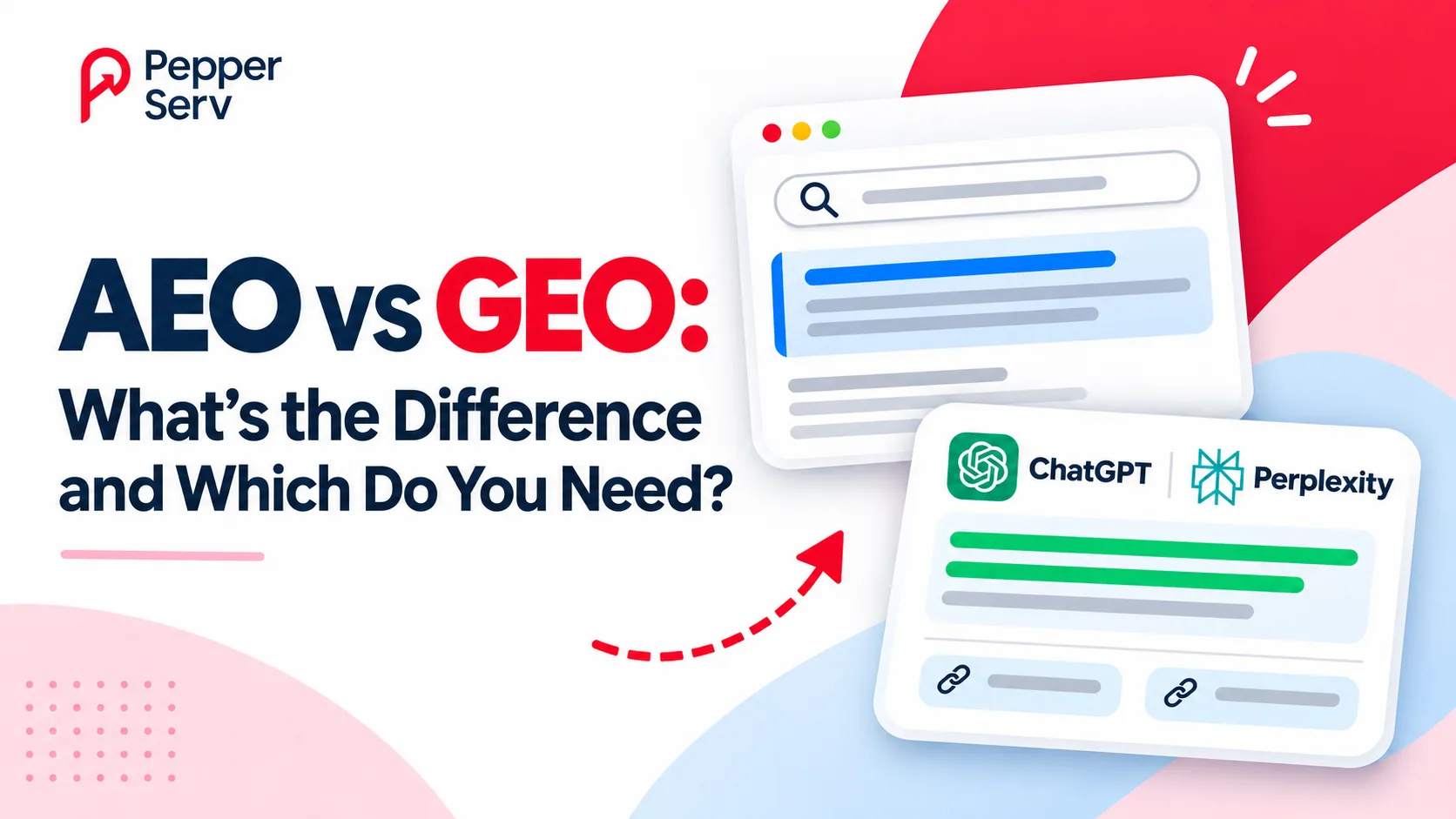
AEO vs GEO is a comparison between two ways of getting your content used by AI powered search. Answer Engine Optimization (AEO) focuses on getting your content pulled out as a direct, concise answer. Generative Engine Optimization (GEO) focuses on getting your content referenced, synthesized and cited inside AI generated responses.
Search no longer ends at ten blue links. Google shows AI Overviews, ChatGPT and Perplexity answer questions in full sentences, and voice assistants read out a single result. A user can get a complete answer without ever visiting your website, which is why being the source of that answer now matters as much as ranking.
This guide explains what AEO and GEO mean, how they differ, how both sit on top of SEO, and which one your business should prioritise first.
Get your AEO & GEO audit done by Pepper Serv
Find out whether your brand wins answers in Google and gets cited in ChatGPT and Perplexity. Enter your website and we will send you a report.
What Are AEO and GEO?
Answer Engine Optimization (AEO) is the practice of structuring content so that search engines and answer engines can lift it out as a direct answer. Think featured snippets, People Also Ask boxes, voice search responses and short answer panels. The content is written to answer one specific question quickly and clearly. Our guide on what is AEO covers it in depth.
Generative Engine Optimization (GEO) is the practice of making your content and brand usable by generative AI tools such as ChatGPT, Perplexity, Gemini and Google AI Overviews. These tools do not just display one result. They read several sources, combine them and write a new answer. GEO aims to make your brand one of the sources they trust and mention. Read more in our guide on what is GEO.
A quick way to separate the two: AEO is about being the answer. GEO is about being the source behind the answer.
One note on the name. GEO here has nothing to do with geographic targeting or local search. It stands for Generative Engine Optimization, and the term first appeared in academic research on AI generated answers. In the industry, many teams use AEO and GEO as near synonyms, which adds to the confusion.
What Is the Difference Between AEO and GEO?
The core difference is extraction versus synthesis. AEO tries to get a piece of your content displayed as it is. GEO tries to get your information understood, combined with other sources and attributed to you.
| Factor | AEO (Answer Engine Optimization) | GEO (Generative Engine Optimization) |
|---|---|---|
| Main goal | Win the direct answer | Become a trusted source cited in AI responses |
| Where it shows up | Featured snippets, People Also Ask, voice answers | ChatGPT, Perplexity, Gemini, Google AI Overviews |
| How content is used | Extracted and displayed | Interpreted, combined with other sources and cited |
| Best content format | Short, clear answers, FAQs, definitions, lists, tables | In depth coverage, original data, clear entities, citable facts |
| Query type | Specific, factual questions | Broad, multi part or exploratory questions |
| Key signals | Answer first structure, schema markup, concise formatting | Authority, third party mentions, brand consistency, verifiable facts |
| What you track | Snippet ownership, PAA appearances, zero click visibility | Citation frequency, brand mentions, AI share of voice |
Both depend on content that is accurate, structured and credible. The table shows where the emphasis changes, not where one strategy stops and the other starts.
What Does AEO vs GEO Look Like in a Real Example?
Take a Shopify skincare brand based in Delhi. Two different questions lead to two different kinds of visibility.
A user searches "how much vitamin C serum should I apply daily?" This is a specific, factual question. A short, direct answer of 40 to 60 words, placed right under a clear heading, can be pulled into a featured snippet or read out by a voice assistant. That is AEO.
Another user asks ChatGPT, "Which vitamin C serums work well for oily, acne prone skin in India?" This is a broad, comparison style question. The AI will draw from reviews, ingredient guides, brand pages and expert mentions to build its reply. Your brand appears only if it has depth on its own site and credible mentions elsewhere. That is GEO.
The same brand needs both. The first win comes from tight, structured answers. The second comes from authority built over time.
SEO vs AEO vs GEO: How All Three Fit Together
SEO, AEO and GEO are not rivals. They are three layers of the same visibility effort, and each one answers a different question about your content.
| Factor | SEO | AEO | GEO |
|---|---|---|---|
| Core question | Can people find my page? | Can an engine extract my answer? | Will an AI cite and recommend my brand? |
| Primary goal | Rank higher and earn clicks | Win the answer slot above the results | Be cited inside AI generated responses |
| Main platforms | Google, Bing | Google snippets, PAA, voice assistants | ChatGPT, Perplexity, Gemini, AI Overviews |
| Content focus | Keywords, intent match, helpful pages | Concise answers, FAQs, schema | Depth, original data, entities, authority |
| Key signals | Backlinks, technical health, relevance | Structure, schema, clarity | Brand mentions, trust, consistency across the web |
| Success metrics | Rankings, organic traffic, conversions | Snippet wins, PAA visibility | Citations, mentions, AI share of voice |
SEO helps people find your content. AEO helps answer engines extract it. GEO helps AI systems use and cite it.
How Do AEO and GEO Fit Into SEO?
Neither AEO nor GEO replaces SEO. Both are built on it. If search engines cannot crawl, index and understand your pages, an answer engine has nothing to extract and an AI model has nothing to cite.
Here is how the layers connect in practice:
- Crawlability and indexing let search engines and AI crawlers reach your content in the first place.
- Clear structure (descriptive headings, short paragraphs, lists and tables) makes content easy to extract.
- Topical authority shows that your site covers a subject properly, which helps both rankings and citations.
- Credibility signals such as author details, accurate statistics and third party mentions give AI tools a reason to trust you.
The fundamentals stay the same: useful content, technical accessibility, clear structure and credibility. What changes is how that content is discovered and presented. A combined approach makes your content easy to find, understand, extract and reference across traditional search and AI search.
AEO vs GEO: Which Should Your Business Focus On?
Most businesses need both, but the order and weight depend on your situation.
Start with AEO if:
- Your site is new or your SEO foundation is still being built.
- Your audience asks specific, factual questions, such as pricing, eligibility, "how to" or "what is" queries.
- You run a local, service led or EdTech business where quick answers drive enquiries.
Start with GEO if:
- You already rank reasonably well and want to appear in AI answers too.
- Your buyers compare options before deciding, as in SaaS, D2C and high consideration services.
- Competitors are being named in ChatGPT or Perplexity answers and you are not.
For a small business: AEO is usually the easier first step. It relies on content changes you control, such as answer first writing, FAQs and schema, and it also improves your normal SEO. GEO then builds on that foundation through deeper content and brand mentions, which take more time.
The practical rule: fix SEO first, add AEO quickly, and invest in GEO steadily.
How to Do AEO and GEO Together
Because the work overlaps, you do not need two separate programmes. Run one content and authority plan, then report results separately.
- Write clear, direct answers. Place a short answer of 40 to 60 words directly under each question style heading before expanding on it.
- Use descriptive headings and scannable formatting. Short paragraphs, lists and tables help both extraction and summarisation.
- Add original research and credible statistics. Your own data, case studies and first hand results give AI tools something distinctive to cite. Always name the source.
- Keep content accurate and updated. Outdated figures reduce trust. Refresh key pages on a regular schedule and show the updated date.
- Build authority beyond your website. Mentions on relevant publications, directories, review platforms and communities help AI systems confirm who you are and what you are known for.
- Make the site crawlable and use structured data. FAQ, Article, Organization and Product schema where relevant, plus a clean sitemap and fast pages.
- Keep your brand details consistent. Use the same name, descriptions and service details across your website, social profiles and listings.
- Track both sets of metrics. Monitor featured snippets and PAA for AEO, and citations, mentions and AI share of voice for GEO.
Where Should You Start With AEO and GEO?
The main points to take away:
- AEO wins direct answers. GEO wins citations in AI generated responses.
- Both build on SEO and neither replaces it.
- The same well structured, credible page can serve all three.
- Measurement is where they differ, so track snippets and citations separately.
- A steady, combined plan works better than choosing one.
If you are not sure where your site stands, begin with an audit of your top 10 pages. Check whether each one gives a clear answer, uses structured data and carries credible proof.
Want your brand in answers and AI citations?
At Pepper Serv, we help D2C, SaaS and EdTech brands in India and the UAE across SEO, AEO and GEO. For WashOn, that meant 166 AI answers citing washon.ae.
FAQs
Is AEO the same as GEO?
Not exactly. They overlap heavily and many teams use the terms interchangeably, but the focus differs. AEO aims to get your content extracted as a direct answer, while GEO aims to get your brand cited and referenced inside AI generated responses.
Which comes first, AEO or GEO?
AEO usually comes first because it is faster to apply. Clear answers, FAQs and structured data are changes you control directly. GEO builds on that with deeper content, original data and brand mentions, which take longer to earn.
Can one piece of content work for both AEO and GEO?
Yes. A page with a short, direct answer at the top and in depth, well sourced coverage below it can win snippets and also be cited by AI tools. The difference is emphasis, not a separate page for each.
Do AEO and GEO replace SEO?
No. SEO remains the foundation. Without crawlable, indexed and trusted pages, there is nothing for answer engines to extract or AI tools to cite. AEO and GEO extend SEO rather than replace it.
How do you measure AEO vs GEO results?
For AEO, track featured snippet ownership, People Also Ask appearances and direct answer visibility. For GEO, track how often AI tools cite or mention your brand, which sources they use and your share of voice across AI generated answers. Standard SEO tools cover the first set, and AI visibility trackers cover the second.
Which is more important for a small business, AEO or GEO?
AEO is usually the better starting point for a small business, since it improves existing pages at low cost and also supports SEO. GEO becomes more important as you grow and compete for broader, comparison style queries.
Does GEO mean geographic or local targeting?
No. In this context GEO stands for Generative Engine Optimization. It is about visibility in AI generated answers, not location based targeting.
Do I need schema markup for AEO and GEO?
Schema is strongly useful for AEO and helpful for GEO. It gives search engines and AI systems a clear, machine readable description of your content, but it works best alongside accurate, well structured writing rather than as a replacement for it.
How long does it take to see results from AEO and GEO?
AEO changes can show up as snippet wins within weeks once pages are crawled again. GEO results are slower, because citations depend on authority and mentions that build over months.